
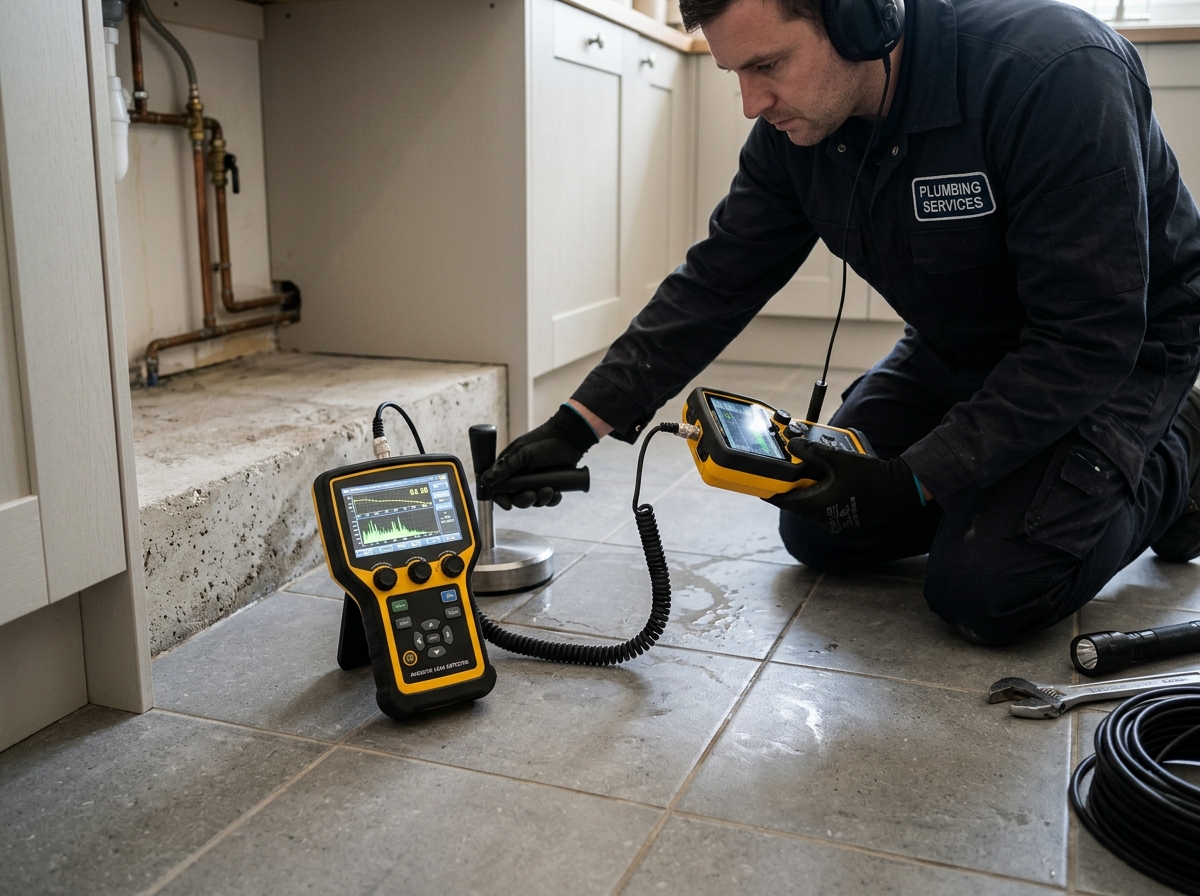
Pinpoint Precision for Under-Slab Copper Lines
Discovering moisture seeping up through flooring or listening to water running when fixtures are shut off can cause understandable anxiety. Historically, plumbers broke through concrete with sledgehammers and jackhammers across large spans in hopes of finding the break. Today, professional slab leak detection Citrus Heights homeowners rely on utilizes multi-technology acoustic listening, electromagnetic pipe locators, and digital pressure gauges to locate failures within inches before touching a tool to your slab.
Accurate leak under slab detection Citrus Heights methods are critical because foundation slabs in Citrus Heights and Sacramento County support post-tensioned or steel-reinforced structural loads. Indiscriminate concrete demolition weakens foundation integrity, destroys custom tile, and inflates repair costs exponentially. By pinpointing the rupture site accurately, you preserve structural concrete and gain clear options for either targeted spot repairs or a clean overhead slab leak reroute.
The Complete Slab Leak Test Protocol
Our systematic slab leak test Citrus Heights protocol isolates variables systematically to ensure flawless diagnostic accuracy:
-
1. Water Meter & Dial Verification
We verify movement on the city water meter's low-flow indicator triangle while all interior fixtures, toilets, ice makers, and irrigation systems are turned off. Continuous spinning confirms pressurized potable water loss.
-
2. Hot vs. Cold Line Isolation
By isolating the cold inlet feeding the domestic water heater, we separate the cold distribution branch from the hot water loop. If pressure drops cease when the water heater is valve-isolated, the leak resides specifically in the hot water piping beneath the slab, leading to specialized hot water slab leak repair.
-
3. Calibrated Pressure Decay Testing
We connect high-precision test gauges to the plumbing system and pump in inert, food-grade nitrogen gas or regulated water pressure. Observing the exact rate of psi decay confirms the relative magnitude of the leak orifice.
-
4. Electromagnetic Pipe Tracing
A transmitter sends an inductive radio frequency signal through the underground copper run. Our digital locator traces the exact directional path, depth, and elbows of the subterranean pipes through concrete and tile flooring.
-
5. Acoustic Ground Listening & Infrared Thermography
Specialized acoustic listening discs amplify high-frequency water turbulence escaping from pressurized breaks beneath the slab. Concurrently, thermal cameras scan the surface floor temperature to confirm hot water pooling patterns.
Why Accurate Detection Prevents Extensive Demolition
A leak's visible water exit point is often ten to thirty feet away from the actual ruptured pipe beneath the foundation. Pressurized water travels along the gravel sub-base, following foundation grade before rising through stress cracks or perimeter seams. Professional electronic leak detection ensures you never tear up flooring in the wrong room.
What the Written Diagnostic Report Includes
Following every electronic leak detection session, Citrus Heights homeowners receive an itemized diagnostic report detailing every technical finding. This document serves two critical functions: outlining transparent restoration avenues and validating homeowners insurance documentation.
Technical Findings Documentation
The report includes recorded static and dynamic pressure levels, depth measurements of the pipe beneath concrete, precise layout schematics marking the detected breach, and thermal imaging screenshots illustrating sub-slab heat dispersion. If signs point to broader system corrosion, we explain why pinhole leak repair or full whole-house repiping may be advisable.
Clear Remediation Roadmap
We present objective pros and cons for direct slab penetration versus non-invasive overhead bypassing. Having these facts in hand empowers homeowners to choose the most cost-effective path for their family while providing all required details for slab leak insurance claims.
Sacramento County Soil & Foundation Dynamics
In neighborhoods like the Sunrise Mall area, Sylvan Corners, and subdivisions along the Antelope border, homes built in the 1970s and 1980s frequently feature Type M or Type L copper pipes laid under thick concrete slabs. Sacramento County's soil profile features high percentages of smectite clay, which swells considerably when saturated by seasonal winter rains and contracts during arid summers. This natural soil movement exerts physical friction against copper lines encased in aggregate, accelerating pipe fatigue and causing subterranean fractures. Our detection team factors in local soil composition and construction styles to deliver accurate diagnostic results every time.